
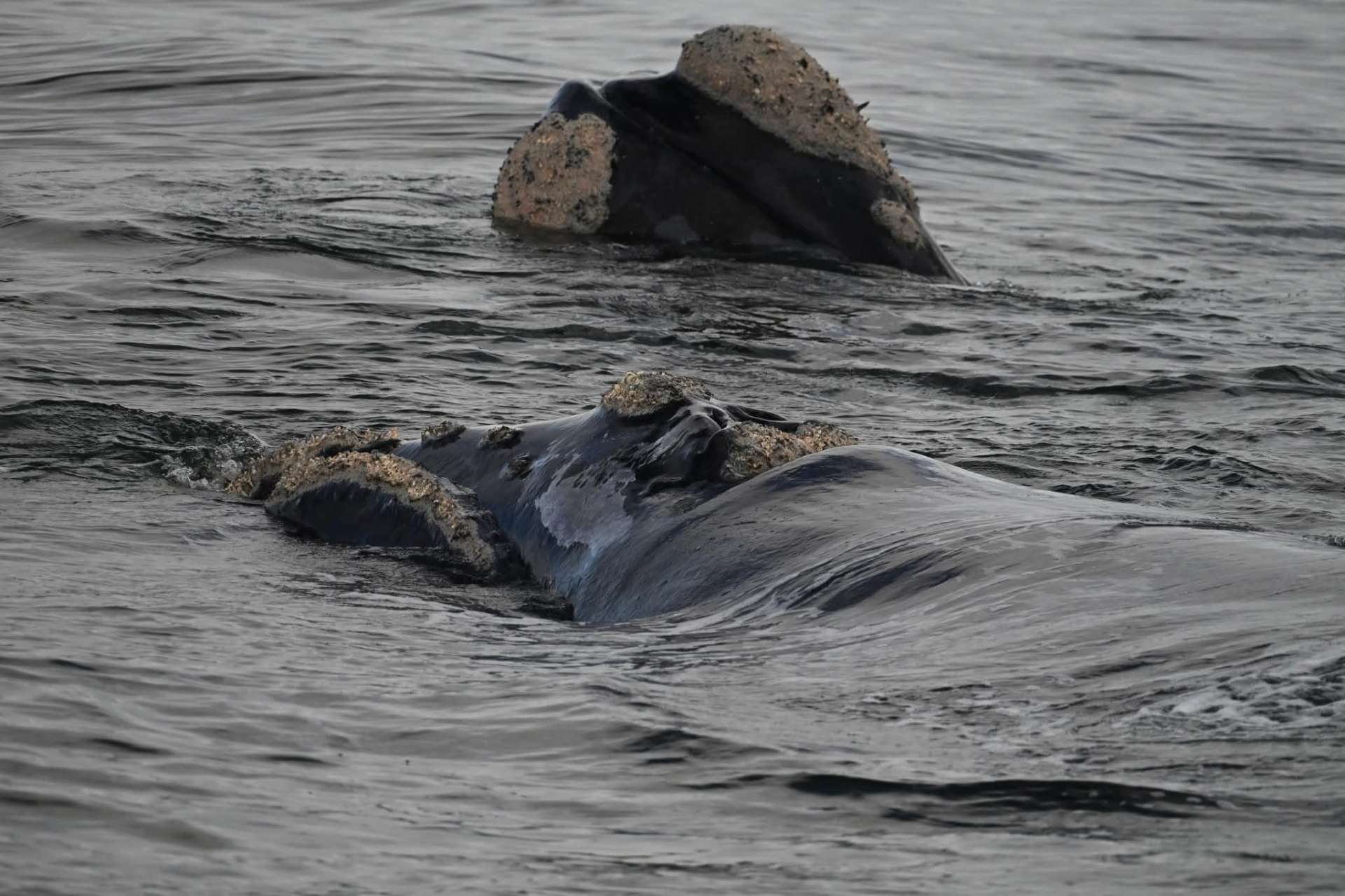
The Southern Right Whale (Eubalaena australis) is South Africa's headline whale species and the reason Hermanus exists as a global whale watching destination. Every year between June and December, thousands of these enormous baleen whales migrate north from Antarctic feeding grounds to mate, calve and nurse in the sheltered bays of the South African coast.
What does a Southern Right Whale look like?
Adult Southern Right Whales reach 13–18 metres long and weigh up to 80 tonnes — roughly the weight of 12 African elephants. They have stocky black bodies, no dorsal fin (a key identification feature), broad pectoral flippers and a wide V-shaped blow when they surface.
The most distinctive feature is the pattern of callosities on the head — roughened patches of skin colonised by whale lice that appear white or yellow against the black skin. The callosity pattern is unique to each individual and is used by researchers as a kind of fingerprint to identify and track returning whales year after year.
Behaviour you'll see in South African waters
- Calving and nursing: mothers give birth in shallow, sheltered bays. Newborns stay within metres of their mother for months.
- Sailing: Southern Rights are famous for raising their tail flukes above the water and letting the wind push them along — apparently for play.
- Breaching: 60-tonne whales launching their entire bodies clear of the water — one of the great wildlife spectacles on earth.
- Lobtailing: slapping the tail flukes on the water surface, possibly as communication.
- Spyhopping: raising the head vertically out of the water to look around.
The South African migration
Southern Right Whales spend summer (December–April) feeding on copepods and krill in the cold, productive waters of the Southern Ocean near Antarctica. As autumn arrives they migrate north — pregnant females first, then other adults — to the coastal bays of South Africa, Australia, Argentina and southern Chile.
The South African population favours the stretch of coast between False Bay and Plettenberg Bay, with Walker Bay (Hermanus) and De Hoop Marine Protected Area holding the highest concentrations. By December most have left for the southward return migration.
Where to see Southern Right Whales
- Hermanus & Walker Bay: the world's best shore-based viewing. Walker Bay Whale Guide · Southern Rights in Walker Bay.
- Gansbaai: permitted boat-based trips with marine Big 5. Whale Watching Gansbaai.
- False Bay (Cape Town): reliable boat-based sightings. Whale Watching Cape Town.
- Mossel Bay: sheltered Garden Route bay with calving cows. Whale Watching Mossel Bay.
- Plettenberg Bay: alongside Humpbacks and Bryde's Whales. Whale Watching Plettenberg Bay.
Conservation
Commercial whaling reduced the global Southern Right Whale population to a few hundred animals by 1935 when full international protection was granted. The South African population has recovered to an estimated 6,000 animals and grows by roughly 7% per year. The species is no longer critically endangered in South African waters, though climate change and shifting krill availability remain long-term threats.
How to see them responsibly
South African whale watching is tightly regulated. Only permitted boat operators may approach whales closer than 300 metres, and even they may not approach closer than 50 metres. Land-based viewing along the Hermanus Cliff Path is unrestricted — and arguably the best way to see Southern Right Whales without affecting them at all.